We Must Listen to Voices from the Front Lines

The War Diaries of Louis E. Wren: A Powerful First-Hand WWII Story Preserved — Aldridge Street Print & Media

November, 2025

We Must Listen to Voices from the Front Lines

One of the most effective ways to prevent war is to show what it’s really like: the night watch on a frigid steel deck, a tanker’s engines wobbling under threat, rumours swirling among the crew, the wives and children waiting at home, and the politicians far away pressing “go.”

Since 2006 I’ve worked with dozens of veterans and their families to edit and publish their stories, and The War Diaries of Louis E. Wren by his son, Christopher Wren, stands out.

Christopher discovered two handwritten journals after his father, Louis Edward Wren, passed away. These notebooks chronicle his father’s years in WWII first as an engineer aboard the oil-tanker MV Corbis in the British Merchant Navy, making perilous convoy trips through the Mediterranean and across the Atlantic to deliver oil to the UK. In 1941, Louis joined the Royal Air Force, training as a mechanical engineer on Wellington and Lancaster bombers and being posted to bases in Iran, Iraq, and Libya.


Author Christopher Wren’s paternal grandparents, Arthur and Lilian Wren. Both were volunteer drivers in World War I, and they may have been the inspiration for his father Louis’s volunteering in the Merchant Navy before WWII broke out.

When I joined the project as the editor (through Tellwell Publishing in Victoria, BC), I saw the journals as museum exhibits: raw, unfiltered, and requiring clarity of context so they could speak for themselves. Chris had set the scene well, writing about what was happening in England, on the Continent, in the Mediterranean or the Middle East when Louis was on duty, so we just needed to ensure the context and journals fit together.

After the edit was complete, Chris wrote to me: “You had questions on the content and expressions which led me to do more homework and to include many footnotes to explain nautical and air-force terminology. This greatly enhanced the substance and readability of the book and also made me think about the content from a different perspective.”
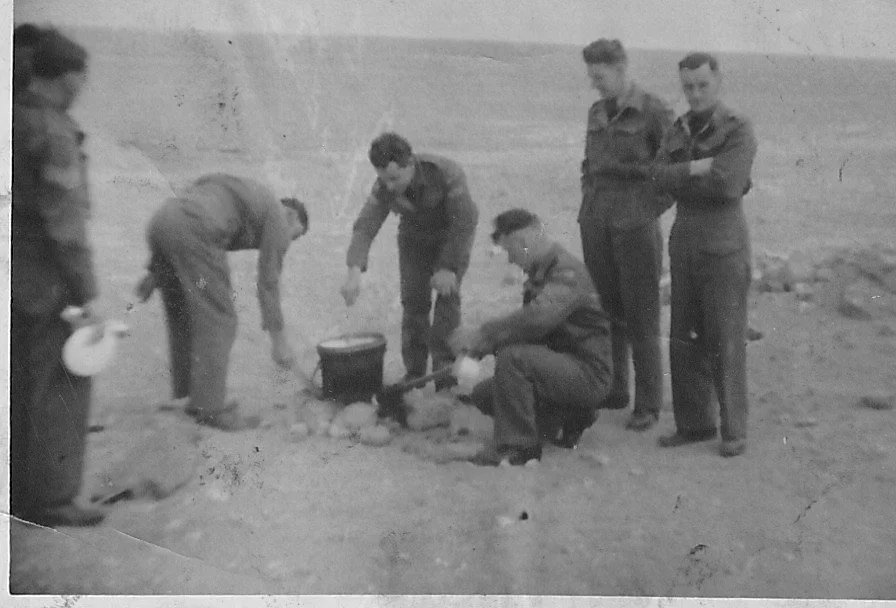
Louis E. Wren (kneeling) and comrades cooking stew in the North African desert on a trip to RAF base Gambut, following the path of Montgomery’s 8th Army.


I also applied The Chicago Manual of Style to bring consistency and ensure the voices of father and son melded smoothly. Chris’s attention and my suggestions came together to produce a book that draws the reader in and shows what war is like. Chris wrote, “The book greatly benefitted from your careful editing, and attention to grammar and style. Your detailed comments reflected a genuine interest in the book content and your desire to produce a better product on my behalf.”

What struck me most was the contrast between the mundane routine day-to-day aboard ship, as they went about their duties while a torpedo strike or convoy attack could happen at any time. Their only windows into the war were the BBC wire feed and chatter among the crew, which is mind-blowing in our current world of relentless “news.”

Monument to the Merchant Navy on the banks of the Mersey River, Liverpool, UK, to honour all the sailors that were killed in WWII.

If you want to understand war beyond the headlines, you can step into the engine rooms, accompany Louis on late-night watch, and feel a little of what he felt by reading this book, which is available through the author‘s website and everywhere good books are sold.

Interview in Guelph Mercury November 2, 2025

Guelph man pens father’s story based on journals from the Second World War

Chris Wren will sign books at Indigo on Saturday, Nov. 8.

“The War Diaries of Louis E. Wren” tell a first-hand account of the Second World War, from experiences in the British Merchant Navy to the Royal Air Force.

By Joy Struthers

Guelph Mercury Sunday, November 2, 2025

Many of us have learned about the Second World War in history class and heard stories on Remembrance Day, but first-hand accounts are now so few and far between.

Chris Wren, who grew up in Guelph, has published a book based on his father’s daily journals during the war, which tell about his travels with the British Merchant Navy and the Royal Air Force.

Wren is holding a book-signing event at Indigo in Stone Road Mall (435 Stone Rd. W.) on Saturday, Nov. 8, from 11 a.m. to 3 p.m., to showcase his work “The War Diaries of Louis E. Wren.”

He is a University of Guelph graduate also attended Centennial Collegiate Vocational Institute and now lives in the countryside near Markdale, Ont., but said Guelph will always be home.

“My father ended up in Guelph after the war and was a member of the legion and very involved in local initiatives,” Wren said. “England was broken, absolutely shattered after the war, so my family came to Canada in 1947.”

He hopes friends and members of the community will come out to learn about his journey to research his father’s experiences. So far, he said he’s had a great response to the book.

“One of the interesting things about this story is that the book I ended up publishing started out just for family. I wanted my children and my father’s grandchildren to know his history and what he had done,” Wren said.

Louis Wren died in 1978 from illness and never got to tell them his stories.

“I didn’t know he kept journals during the war until after he passed away,” Wren said. “He did talk a little bit about the war, but these shed a whole new light on what he had seen and done.”

Wren said he had the entries typed up and held onto them for decades. Then one day, he started doing research of his own. He knew his father, being from England, started off in the British Merchant Navy and then joined the Royal Air Force.

“He was in the services from 1939,” Wren said. “He was there the day war broke out and had already volunteered, much to my mother’s chagrin, and was in it right until the end, in 1945.”

Wren said the British Merchant Navy was comprised of private ships carrying supplies, which included food, oil, guns and everything England needed. “With England being an island, the British merchants were absolutely critical,” he said.

When the Germans invaded France and took over the Mediterranean, the merchants could no longer access their regular route and instead had to travel to South America to get shipments of oil, then up the coast to Halifax, N.S., and convoy across the Atlantic Ocean to Liverpool, England.

“It became known as the Battle of the Atlantic, because Germany knew how important these supplies were and put the full force of their U-boats and surface ships to attack these convoys,” Wren said. “They sank hundreds and thousands of ships.”

When the war broke out, his father was on one convoy and out of the 40 ships, 11 were sunk in one night.

“It was a tremendous loss of people and materials and the ships were not allowed to pick up sailors because they would then become targets themselves. It was quite a horrific situation,” Wren said.

And not only was his father living the real fear of not knowing what was happening, where he was going or if he would survive, but Louis was also concerned his family back home might be in danger, with the looming threat of an invasion in England.

“After getting chased across the Atlantic a number of times and his convoys being attacked, he got out and joined the Royal Air Force and was sent to North Africa for the last two years of the war,” said Wren. “In the book, it describes a three-month voyage that was quite an adventure, to put it mildly.”

As part of his research, Wren went to search archives in London, England and even sailed as a passenger on a private merchant ship, a container ship, he said, in 2019 from Halifax to Liverpool.

“It would have been the same route as his convoy, 80 years earlier,” he said. “So that was a big thrill for me.”

Revisiting his father’s journals, writing and researching brought him closer to his family and his father after so many years.

“It’s a wonderful sense of accomplishment for me and I’m very proud of my father,” he said. “My sister and I talk about this often, because it’s her story as much as it is mine, of course.”

Though he started telling the story to pass down to the next generation of their family, he realized it was a good story for everyone. Whether you are reading it from an academic or personal perspective, the Second World War is everyone’s story.

And one his family, who came from the moors of England to the city of Guelph, will remember.


AUTHOR EVENTS

September 3, 2025:  Book Launch Presentation on National Merchant Navy Day, at Annesley United Church, Markdale, Ontario. 7-8 pm.  The presentation can be watched on You Tube. Click below.


UPCOMING EVENTS

October 18, 2025. Chris will attend a book signing event at the Indigo book store at Heritage Mall, Owen Sound, from 11:00 to 1:00 pm.

October 24-25, 2025: Chris will be present at the Owen Sound Local Authors Book Fair. Friday and Saturday from 1 – 4 pm.

824 1st Ave W, Owen Sound ON N4K4K4

November 8, 2025. Chris will be at the Indigo book store Stone Road Mall, Guelph, for a book signing from 11:00 to 3:00 pm.

November 19, 2025: Chris will be giving a presentation on “A first hand account of time in the Royal Air Force; a three month voyage on a troop ship and time in RAF bases in Iraq and Libya in WW2”. British Columbia Aviation Museum, Victoria, British Columbia. 7-9 pm.

November 20, 2025: Chris will give a presentation “My Fathers experiences in the British Merchant Navy in WW2” at the Canadian Forces Base Esquimalt Naval and Military Museum, Victoria, British Columbia. 2-3 pm.

Author Presentation National Merchant Navy Day

Author Chris Wren will give a presentation at Annesley United Church in his hometown of Markdale, Ontario, on National Merchant Navy Day, September 3, 2025. The talk will focus on his father’s experiences in the British Merchant Navy in the early phase of the Second World War. The U-boat commanders referred to this period as “The Happy Time” due to their feeling of invincibility and the high rate of success of sinking the merchant ships while easily evading the few, and ill prepared, convoy escorts. The presentation will begin at 7 pm. Donations to Annesley United Church will be accepted. Signed copies of the book will be available.

Go to AUTHOR EVENTS for a link to watch this presentation on YOU TUBE.

Author Interview published July 16, 2025

A  CITIZEN-WARRIOR’S TALE, DEFTLY TOLD BY HIS SON

Many men who served in war talk little about their experiences when they come home. But some men leave behind written memoirs, hidden away in desks or boxes and discovered by their family after they die. Such a man was Louis Wren, whose two wartime journals were discovered in his desk drawer by his wife and his son, Chris Wren, after his death. The war-driven journeys across ocean and desert described in these journals transformed Chris’s life and led him to write and publish The War Diaries of Louis E. Wren, available at Speaking Volumes bookstore in Markdale and at Amazon.ca and Indigo.ca.

When war with Germany began in 1939 Louis Wren, a British citizen, was an engineer aboard an oil tanker in the British Merchant Navy. His first journal describes his voyages through the Mediterranean and the Atlantic, enduring violent storms and mine fields, zig zagging in convoys to avoid U-boat attacks. In 1941 Louis Wren joined the Royal Air Force as a mechanical engineer servicing Wellington bomber engines, and in 1943 he was transferred to the Middle East and North Africa. His second journal describes a three-month journey aboard a troop ship heading for his new posting, including a near mutiny by rowdy troops that he describes with detached humour. The journal also recounts his time spent in RAF camps in Iran and Libya. After the war, Louis and his family immigrated to Canada, settling in Guelph.

Although Chris Wren had no previous experience with historical research, the discovery of his father’s diaries led him on his own journey. He conducted extensive research during several trips to the National Archives in England, and in 2019 he sailed on a container ship from Halifax to Liverpool to retrace the Atlantic convoy routes his father had taken 80 years earlier. The story of the combined journeys of father and son are the heart of Chris Wren’s book. When he started he had no idea of the enormity of the research he would conduct into both his father’s wartime exploits and the war in general – but he regrets not a minute of it.

As a child, Chris saw wartime photos in the family album but learned little directly from his father. One stark story that sticks in his memory, though, is his father’s account of watching sailors leaping into the sea from a burning ship, with no possibility of rescue. A less horrid story had to do with his father’s mates burying beer bottles in the desert sand, pouring gasoline around the bottles: the desert heat would evaporate the gas so quickly it would cool down the beer. Despite his reticence beyond these few stories, Louis was a sociable man with a great sense of humour, says his son – a man whose war years shaped his post-war involvement in both the Air Cadet League of Canada and the Canadian Legion (Louis also served as a school board trustee.)

One of the triumphs Chris experienced in studying his father’s diaries was the realization of how observant Louis Wren was, and how eloquent he was as a writer (including his reflections on religion and philosophy through a citizen-warrior’s eyes.) And Chris was also moved by his father’s empathy for German sailors in U-boats as they were being depth-charged by convoy escort ships – men trapped in the same war as Louis was.

Chris and his sister Melody reflect sadly on the likelihood that their father wrote at least one other journal that has been lost, since there is a two year wartime gap for which Louis left no written record. And Melody says that in light of what they know now, she and Chris regret they never got to know their father better when he was alive.

What would Chris say to his father if he could? “We’re proud of you,” says Chris. “You served your country for six years, you were brave enough to re-settle our family in Canada, and I cherish every moment you shared with me when I was a child.”

Retired now from his career as an environmental scientist and living with his wife, Lisa, on their country property near Markdale, Chris continues to research family and community history, using the skills he learned while exploring his father’s wartime story. His advice to others with a yen for historical research: “Start now. Talk to your elderly relatives and friends and record their stories, even if you’re not writing a book about them.”

Reading Chris’ book, one is left with the distinct feeling that Louis Wren would be as proud of his son’s achievements as Chris is of his father’s vibrant life in wartime and in peace.

Chris Wren will share his book and his father’s story at a presentation at Annesley United Church in Markdale on Wednesday September 3, which is Merchant Navy Veterans Day – a day to commemorate the sacrifices and courage of over 30,000 merchant seafarers, men and women, who died during the Second World War, and to acknowledge the vital role of merchant seafarers in keeping the UK supplied with food and war materiel. Louis Wren was one of them who survived, and whose written account enriches our knowledge of their bravery.

More details of his September 3 presentation at Annesley will be posted closer to the event, and further information can be found on Chris’s website, https://chrisdwren.com


Author on container ship crossing the Atlantic Ocean

In the fall of 2019 I booked a passage on a container ship on a voyage across the Atlantic Ocean from Halifax, Nova Scotia, to Liverpool, United Kingdom. I wanted to experience the ocean crossing and follow the same route that the convoys took during the Second World War some 80 years earlier. My father participated in at least four trans-Atlantic convoys during the early part of the war when escort ships were few and ill prepared for the U-Boat threat. His convoys were attacked by U-Boats and enemy aircraft. My ship, the Atlantic Sea was over twice as long and ten times the gross weight of my father’s ship, the M.V. Corbis. We made the crossing in just 6 1/2 days, compared with the 13-15 days required to cross the Atlantic Ocean by the much smaller and slower merchant ships during the war.


Louis E. Wren in uniform.

The photograph on the front cover of the book is a studio photograph of my father in a naval uniform as indicated by the anchor on the hat, and double breasted jacket which was adapted by the British Navy in the 1800’s.  A standard uniform for the Merchant Navy was introduced in 1918 but would rarely be worn during working conditions.  The title of Merchant Navy was conferred upon the service by King George V after the First World War in recognition of the the contribution by merchant sailors.